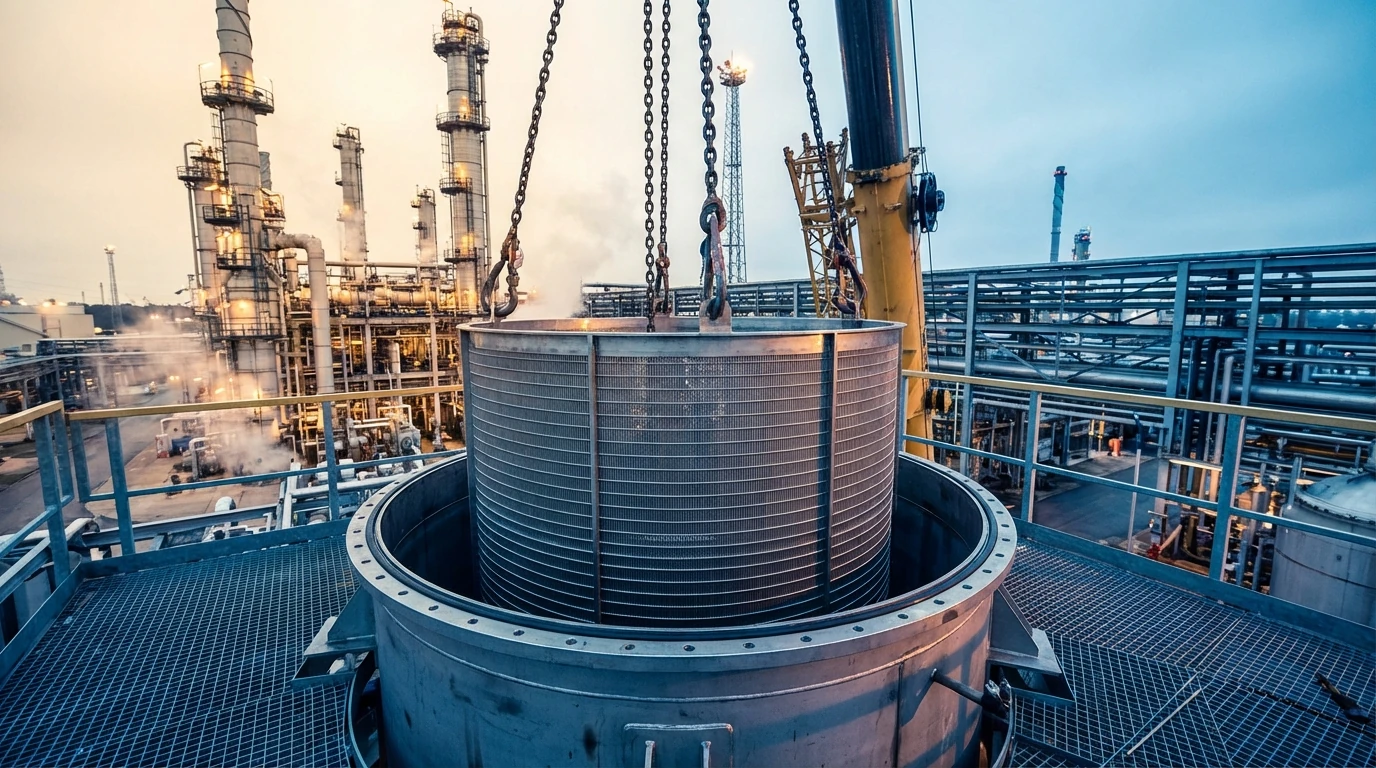
Where Our Screens Work
Dehydration
Cylindrical and flat screens for liquid-liquid and solid-liquid separation.
Refinery Screening
Screens for desalter vessels, crude distillation, and catalyst recovery.
Catalyst Support and Retention
Flat and cylindrical screens as catalyst bed supports in reactors.
Resin Traps
In-line strainer baskets that capture migrated ion exchange resin and protect downstream pumps, exchangers, and instruments in produced-water and amine systems.
Scallops and Header Laterals
Outer-wall scallops and inlet/outlet header laterals for radial-flow reactors and adsorbers — even fluid distribution across the catalyst bed.
Support Grids
Wedge wire support grids retain catalyst, packing, and adsorbent media above bed gratings in fixed-bed and moving-bed reactors.
Screens for Oil, Gas, and Petrochemical
Materials for Oil, Gas, and Petrochemical
Regulatory Compliance
How Screens Fail — and How We Prevent It
Sand erosion at slot edges
Continuous-slot V-wire profile and erosion-resistant material grades selected by sand grain size and flow regime. Slot tolerance verified by photometric inspection.
Stress corrosion cracking (sour service)
Duplex 2205 or Super Duplex for H₂S-bearing streams per NACE MR0175. PMI verification on every batch.
Thermal cycling fatigue
316Ti and 321 stabilized grades resist carbide precipitation and creep at refinery and reactor temperatures up to ~900 °C.
Catalyst loss / dust migration
Slot opening matched to the smallest catalyst particle fraction with safety factor. Resistance-welded crossovers hold slot tolerance under thermal expansion.
What to Send for an Accurate Quote
The more of these you can share when you request a quote, the faster we respond with a defensible specification.
Specify Your Oil, Gas, and Petrochemical Screen
Send your application parameters. We respond within one business day.
REQUEST A QUOTE