Where Our Screens Work
Catalyst Retention and Support
Cylindrical and flat wedge wire screens serve as catalyst bed supports in fixed-bed and moving-bed reactors. Precise slot sizing retains catalyst particles while allowing reactant flow, preventing catalyst loss and downstream contamination.
Reactor Internals
Custom-engineered wedge wire elements function as distribution plates, collection headers, and separation internals inside chemical reactors. Resistance to thermal cycling and chemical attack ensures long service life.
Chemical Filtration
Process filtration screens for removing solid contaminants from liquid chemical streams. Applications include fertilizer slurry filtration, polymer melt screening, and paint pigment classification.
Fertilizer Production
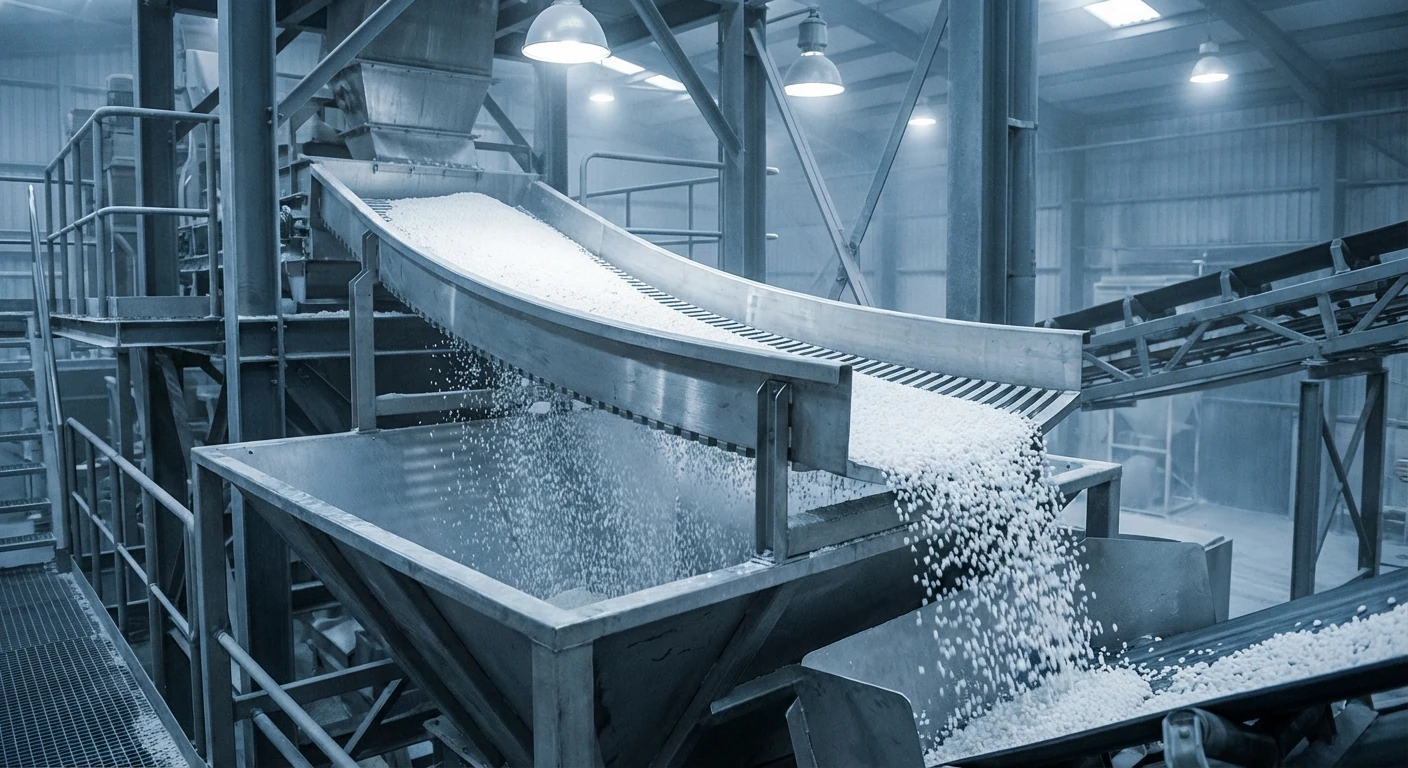
Screens for granulation, sizing, and classification of urea, ammonium nitrate, and NPK fertilizer products. Corrosion-resistant grades handle acidic and alkaline process conditions.
Polymer and Resin Processing
Fine-slot screens for polymer pellet dewatering, resin bead classification, and melt filtration in plastics manufacturing.
Resin Traps
In-line wedge wire strainer baskets capture migrated ion exchange resin and protect downstream pumps, valves, and instruments.
Support Grids
Wedge wire support grids retain catalyst, adsorbent, and packing media above bed gratings in fixed-bed reactors and columns.
Distributor and Collector Systems
Inlet distributors and outlet collectors in radial- and axial-flow vessels — even fluid distribution across packed beds.
Gas-Liquid Contactors
Wedge wire trays and packing supports for absorption, stripping, and reactive distillation columns.
Screens for Chemical Processing
Materials for Chemical Processing
How Screens Fail — and How We Prevent It
Aggressive chemical attack
Material grade selected per service chemistry — SS 316L baseline through Super Duplex; Hastelloy, Inconel, Titanium, or Monel for special-project specifications.
Thermal shock and creep
316Ti and 321 stabilized grades resist carbide precipitation in temperature-cycling reactors. Continuous-weld construction tolerates thermal expansion.
Catalyst dust accumulation
Slot opening matched to the smallest catalyst fraction with safety factor. V-wire profile releases dust during reverse-flow or thermal cycling.
Crevice corrosion at supports
Resistance-welded V-wire to support bars eliminates the crevices that cause localized attack in welded mesh and bar-rack designs.
What to Send for an Accurate Quote
The more of these you can share when you request a quote, the faster we respond with a defensible specification.
Specify Your Chemical Processing Screen
Send your application parameters. We respond within one business day.
REQUEST A QUOTE